
August 11, 2026
Compliant with GB/T17467: Quality Assurance of the YB-24/0.4-2500 Prefabricated Substation
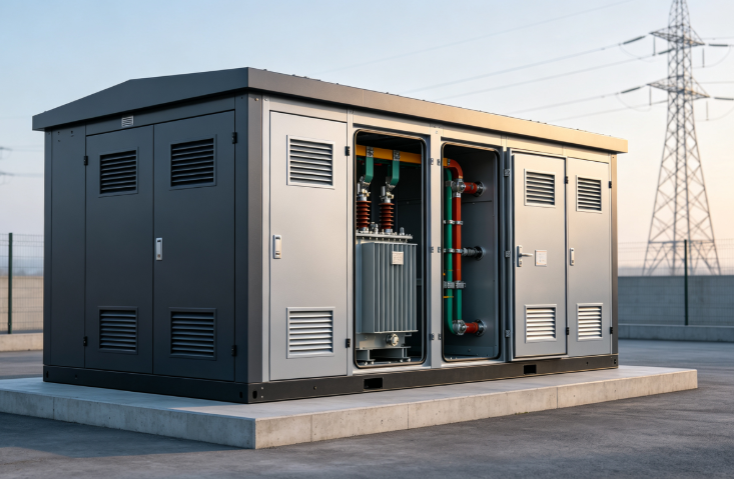
Table of Contents
The Quality Challenge in Prefabricated Substations
Understanding GB/T 17467-2020: The Regulatory Backbone
The YB-24/0.4-2500 High-Capacity Substation: An Overview
Design and Structural Compliance
Type Testing and Factory Testing Under GB/T 17467
Operational Conditions and Environmental Adaptability
Global Market Context: Overseas Adoption Is Accelerating
Regional Deployment Data: Where the YB Series Is Going
Industry Data & Market Comparison
Frequently Asked Questions
1. The Quality Challenge in Prefabricated Substations
Here's something that keeps project managers up at night. You spec a prefabricated substation, you get it delivered, you install it—and then six months later, something fails. Maybe it's the insulation. Maybe it's the switchgear. Maybe it's something else entirely. The cost of that failure isn't just repair bills. It's downtime. It's lost revenue. It's reputational damage.
The reality is that not all prefabricated substations are built the same. The difference between a reliable unit and a problematic one often comes down to one thing: whether it was designed, tested, and manufactured against a rigorous national standard.
In China, that standard is GB/T 17467-2020, High-voltage/low-voltage prefabricated substation. For the YB-24/0.4-2500 high-capacity substation, compliance with this standard isn't just a box-ticking exercise. It's the foundation of quality assurance. It's what separates a substation that performs reliably for decades from one that becomes a maintenance headache.
2. Understanding GB/T 17467-2020: The Regulatory Backbone
GB/T 17467-2020 is the current national standard for high-voltage/low-voltage prefabricated substations in China. It was released on March 31, 2020, and became effective on October 1, 2020, replacing the previous 2010 version. The standard is 92 pages long and contains 168,000 Chinese characters.
What does this standard actually do? It specifies the service conditions, ratings, design and structural requirements, type testing, and factory testing for prefabricated substations. It applies to substations with a high-voltage AC rated voltage of 3.6 kV to 40.5 kV, containing one or more transformers, operating at 50 Hz or below, and installed outdoors in locations that are accessible to the public with personnel protection provided.
Here's something important to understand: GB/T 17467-2020 is not a standalone document. It modifies and adopts the IEC international standard IEC 62271-202:2022, High-voltage switchgear and controlgear – Part 202: AC prefabricated substations for rated voltages above 1 kV and up to 52 kV. This alignment with international standards means that a substation compliant with GB/T 17467-2020 also meets globally recognized technical requirements. That matters for projects that need to satisfy both domestic and international specifications—especially as overseas demand for prefabricated substations continues to grow.
3. The YB-24/0.4-2500 High-Capacity Substation: An Overview
The YB-24/0.4-2500 high-capacity substation belongs to the YB series of prefabricated substations—a product family that has been widely deployed across China's urban and rural power distribution networks and is increasingly finding its way into overseas markets.
Let's break down the designation: "24" refers to the high-voltage side rated voltage of 24 kV. "0.4" indicates the low-voltage side rated voltage of 0.4 kV. "2500" is the rated capacity in kVA—2,500 kVA. This is a substantial unit, designed for applications that require significant power delivery.
The YB-24/0.4-2500 integrates three key components into a compact, factory-assembled package: high-voltage switchgear, the power transformer, and low-voltage distribution equipment. The transformer room can accommodate either dry-type or oil-immersed transformers, with capacity typically ranging from 100 kVA up to 2,500 kVA.
What makes this unit particularly valuable is its physical footprint. Compared to conventional brick-and-mortar substations, a prefabricated substation of the same capacity occupies only one-tenth to one-fifth of the space. That's a massive reduction in land acquisition costs, design workload, and construction time.
But here's the critical point: space savings mean nothing if the unit doesn't perform reliably. That's where GB/T 17467 compliance becomes essential.
4. Design and Structural Compliance
GB/T 17467-2020 sets clear requirements for the design and structure of prefabricated substations. For the YB-24/0.4-2500, compliance means several things:
Modular Integration. The standard requires that all components—high-voltage switchgear, transformer, low-voltage switchgear—be integrated into a cohesive, factory-assembled unit. This isn't just about convenience. It's about ensuring that the interfaces between components are properly engineered and tested before the unit leaves the factory.
Personnel Protection. Because these substations are installed in locations that may be accessible to the public, the standard mandates specific personnel protection measures. This includes enclosure design that prevents accidental contact with live parts, proper grounding systems, and clear warning signage.
Environmental Sealing. The enclosure must provide adequate protection against environmental factors—rain, dust, humidity, and temperature extremes. The YB series is designed for outdoor installation with weatherproof enclosures that meet these requirements.
Internal Arc Protection. The standard addresses internal arc fault protection. For the YB-24/0.4-2500, this means the substation must be designed to contain and safely direct the effects of an internal arc, protecting both personnel and surrounding equipment.
The YB series features a three-compartment enclosure structure: high-voltage compartment, transformer compartment, and low-voltage compartment. This European-style layout—which originated in European utility practice and was adopted as the preferred format for IEC markets—provides the best balance of safety isolation, maintenance accessibility, and thermal management.
5. Type Testing and Factory Testing Under GB/T 17467
This is where the rubber meets the road. GB/T 17467-2020 mandates two distinct levels of testing: type testing and factory testing.
Type testing is performed on a representative sample of the product design. It's the comprehensive validation that the design itself is sound. Type tests under GB/T 17467 include:
Dielectric tests (verifying insulation strength)
Temperature rise tests (ensuring the unit can handle its rated load without overheating)
Short-circuit withstand tests (confirming the unit can survive fault conditions)
Mechanical operation tests (checking that all moving parts function correctly over their intended lifecycle)
Internal arc fault tests (validating the arc containment design)
Once a design passes type testing, it's certified. But that's only half the story.
Factory testing is performed on every single unit before it leaves the factory. This is the quality control checkpoint that catches manufacturing defects. Factory tests under GB/T 17467 include:
Insulation resistance measurements
Dielectric withstand tests at reduced voltage
Verification of correct operation of all mechanical and electrical interlocking devices
Measurement of main circuit resistance
Functional tests of all auxiliary and control circuits
For the YB-24/0.4-2500 high-capacity substation, this dual-layer testing regime means that every unit is verified against the standard's requirements. Not just the design—every single unit.
6. Operational Conditions and Environmental Adaptability
GB/T 17467-2020 specifies the operational conditions under which a prefabricated substation must perform reliably. For the YB-24/0.4-2500, these conditions include:
Altitude. The standard typically applies to installations up to 2,000 meters above sea level. Above this altitude, derating factors may apply due to reduced air density affecting insulation and cooling.
Ambient Temperature. The unit must operate within a specified temperature range. For most applications, this is -25°C to +40°C, with daily averages not exceeding certain limits.
Humidity. The standard addresses both daily and monthly average relative humidity limits, typically not exceeding 95% at 25°C for daily averages.
Seismic Considerations. For installations in seismically active regions, the substation must be designed to withstand specified levels of ground acceleration.
What this means in practice is that the YB-24/0.4-2500 isn't a fair-weather piece of equipment. It's designed to perform across a wide range of environmental conditions—from the freezing winters of northern China to the humid summers of the south, from coastal installations with salt spray to high-altitude mountain sites.
7. Global Market Context: Overseas Adoption Is Accelerating
The demand for prefabricated substations—particularly high-capacity units like the YB-24/0.4-2500—is accelerating globally. And here's the key insight: overseas markets are adopting these solutions at a remarkable pace.
Let's look at the numbers. The global MV/LV Prefabricated Transformer Substation market was valued at US12,870millionin2025andisanticipatedtoreachUS12,870millionin2025andisanticipatedtoreachUS 19,934 million by 2032, at a CAGR of 6.5%. The broader Prefabricated Substations market is projected to grow from US944millionin2025toUS944millionin2025toUS 1,421 million by 2031, at a CAGR of 7.1%.
But here's what's really interesting for overseas deployment. The containerised substation market—a category that closely overlaps with prefabricated substations—is projected to grow from $3.2 billion in 2025 to $7.2 billion by 2035, registering a CAGR of 8.5%.
Regional growth rates tell an even clearer story:
China leads with 11.5% CAGR, driven by industrial electrification and renewable integration
India follows at 10.7% CAGR, with strong adoption in solar parks and industrial corridors
Germany at 9.8% CAGR, leveraging containerised substations for wind farms and EV charging infrastructure
France at 8.9% CAGR, prioritizing modular substations for rail electrification
United Kingdom at 8.1% CAGR, expanding adoption in offshore wind projects
Export demand from Africa and Southeast Asia is also increasing significantly. The Middle East & Africa region exhibits the highest regional growth trajectory with a projected CAGR of 7% during 2025-2032, propelled by expanding oil and gas projects, mining sector development, and utility infrastructure investments.
8. Regional Deployment Data: Where the YB Series Is Going
The YB series isn't just a domestic product. It's being deployed across multiple overseas markets, and the evidence is substantial.
Saudi Arabia. This is perhaps the most visible overseas market for YB series substations. Saudi Arabia's solar energy sector has entered a phase of aggressive capacity addition, with the Kingdom targeting 50% renewable energy by 2030 and the National Renewable Energy Program driving a competitive auction pipeline exceeding 30 GW. The YB series package substation, with its 11kV rating and Saudi grid compatibility, is purpose-built for this role. These units feature IP54/IP55 outdoor enclosures rated for 55°C ambient temperatures, transformer Class H insulation, and IEC 62271 switchgear with SASO compliance. The extreme desert conditions of Saudi Arabia—where summer temperatures regularly exceed 50°C and sandstorms are common—demand the kind of robust construction that GB/T 17467 compliance ensures.
Europe. The YB Series European-style package substation has become a dominant format for 11kV wind farm collector stations across the continent. The "European-style" descriptor refers to the three-compartment layout that originated in European utility practice and was adopted as the preferred format for IEC markets. This architecture provides the best balance of safety isolation, maintenance accessibility, and thermal management—critical factors for wind farms where maintenance windows are narrow and shutting down an entire collector node means lost generation revenue.
Southeast Asia. A 150 kV prefabricated substation project in Indonesia's Subang Industrial Park, West Java, successfully achieved first-time energization in 2026. This demonstrates the growing acceptance of prefabricated substation technology in Southeast Asian markets, where rapid industrialization and urbanization are driving demand for quick-deploy power infrastructure.
Africa. The YB series has been supplied to renewable energy projects across Africa, the Middle East, and Southeast Asia for more than 15 years. The Africa region presents significant opportunities for prefabricated substations, driven by electrification initiatives and the need to support large-scale infrastructure projects.
The YB-24/0.4-2500, with its GB/T 17467 compliance and IEC-aligned certification, is well-positioned to serve these diverse overseas markets. The unit's certification—meeting both GB and IEC standards—provides the regulatory confidence that overseas project managers and utility engineers require.
9. Industry Data & Market Comparison
Market Segment | 2025 Value | 2030/2031/2032 Projection | CAGR |
Global MV/LV Prefabricated Transformer Substation Market | US$ 12,870M | US$ 19,934M (2032) | 6.5% |
Global Prefabricated Substations Market | US$ 944M | US$ 1,421M (2031) | 7.1% |
Containerised Substation Market | US$ 3,200M | US$ 7,200M (2035) | 8.5% |
Modular Substation Market | US$ 20,340M | US$ 33,640M (2032) | 7.44% |
Packaged Substation Market | US$ 40,180M | US$ 56,070M (2031) | 5.71% |
E-House Market | US$ 1,890M | US$ 3,609M (2031) | 9.4% |
Mobile Prefabricated Substation Market | US$ 5,625M | US$ 9,042M (2032) | 6.4% |
Containerized & Prefabricated Substation Market | US$ 888M | US$ 1,325M (2032) | 6.0% |
Regional Breakdown:
Region | Market Share / Growth | Key Drivers |
North America | 32% of global market (2024) | Grid modernization, aging infrastructure, renewable integration |
Asia Pacific | Fastest growing (9.3% CAGR 2024-2033) | Urbanization, industrialization, smart grid investment |
Middle East & Africa | 7% CAGR (2025-2032) | Oil & gas, mining, utility infrastructure |
Europe | Strong growth in renewable sectors | Wind farms, EV charging, rail electrification |
Key Observations from the Data:
The MV/LV prefabricated transformer substation market is the largest segment at US$ 12.87 billion in 2025, reflecting the scale of medium-voltage distribution infrastructure globally.
The containerised substation market is growing at the highest CAGR (8.5%), indicating strong global demand for modular, transportable solutions.
North America currently holds the largest share of the prefabricated substation market at approximately 32%, making it a critical overseas market for GB/T 17467-compliant products.
The Asia Pacific region is poised to experience the fastest growth at 9.3% CAGR, driven by rapid urbanization and industrialization.
Export demand from Africa and Southeast Asia is increasing, with YB series units already deployed across these regions.
The YB-24/0.4-2500's dual GB/IEC certification positions it favorably for overseas markets that require alignment with both Chinese and international standards.
10. Frequently Asked Questions
Q: What is GB/T 17467-2020?
A: GB/T 17467-2020 is the Chinese national standard for high-voltage/low-voltage prefabricated substations. It specifies service conditions, ratings, design and structural requirements, type testing, and factory testing. The standard was released on March 31, 2020, and became effective on October 1, 2020.
Q: What does the "YB-24/0.4-2500" designation mean?
A: "24" refers to the high-voltage side rated voltage of 24 kV. "0.4" indicates the low-voltage side rated voltage of 0.4 kV. "2500" is the rated capacity in kVA—2,500 kVA.
Q: Is GB/T 17467-2020 aligned with international standards?
A: Yes. GB/T 17467-2020 modifies and adopts the IEC international standard IEC 62271-202:2022, High-voltage switchgear and controlgear – Part 202: AC prefabricated substations for rated voltages above 1 kV and up to 52 kV.
Q: What overseas markets are adopting YB series substations?
A: YB series substations have been deployed in Saudi Arabia (solar PV collector systems), Europe (wind farm collector stations), Southeast Asia (industrial parks), and across Africa and the Middle East for renewable energy projects.
Q: How large is the global prefabricated substation market?
A: The global MV/LV Prefabricated Transformer Substation market was valued at US12,870millionin2025andisanticipatedtoreachUS12,870millionin2025andisanticipatedtoreachUS 19,934 million by 2032, at a CAGR of 6.5%. The broader Prefabricated Substations market is projected to grow from US944millionin2025toUS944millionin2025toUS 1,421 million by 2031.
Q: What environmental conditions can the YB-24/0.4-2500 withstand?
A: The unit is designed for altitudes up to 2,000 meters, ambient temperatures from -25°C to +40°C (and up to 55°C for specific desert applications with appropriate ratings), and relative humidity conditions with daily averages not exceeding 95% at 25°C.
Q: Why is the YB series called "European-style"?
A: The "European-style" descriptor refers to the three-compartment layout (HV, transformer, LV) that originated in European utility practice and was adopted as the preferred format for IEC markets because it provides the best balance of safety isolation, maintenance accessibility, and thermal management.
Q: How does a prefabricated substation compare to a conventional brick-and-mortar substation in terms of deployment time?
A: A properly specified YB Series prefabricated substation can reduce collector station deployment time by 80–90% compared to traditional built-on-site substations, because factory assembly eliminates the coordination risk between civil works, equipment delivery, and on-site commissioning.
Q: What is the growth outlook for the Middle East prefabricated substation market?
A: The Middle East & Africa region exhibits the highest regional growth trajectory with a projected CAGR of 7% during 2025-2032, propelled by expanding oil and gas projects, mining sector development, and utility infrastructure investments