
July 10, 2026
Application of Intelligent Ring Main Unit in Distributed Energy Grid Connection: Implementation of Primary and Secondary Integration Technology and Fault Self-Healing Function
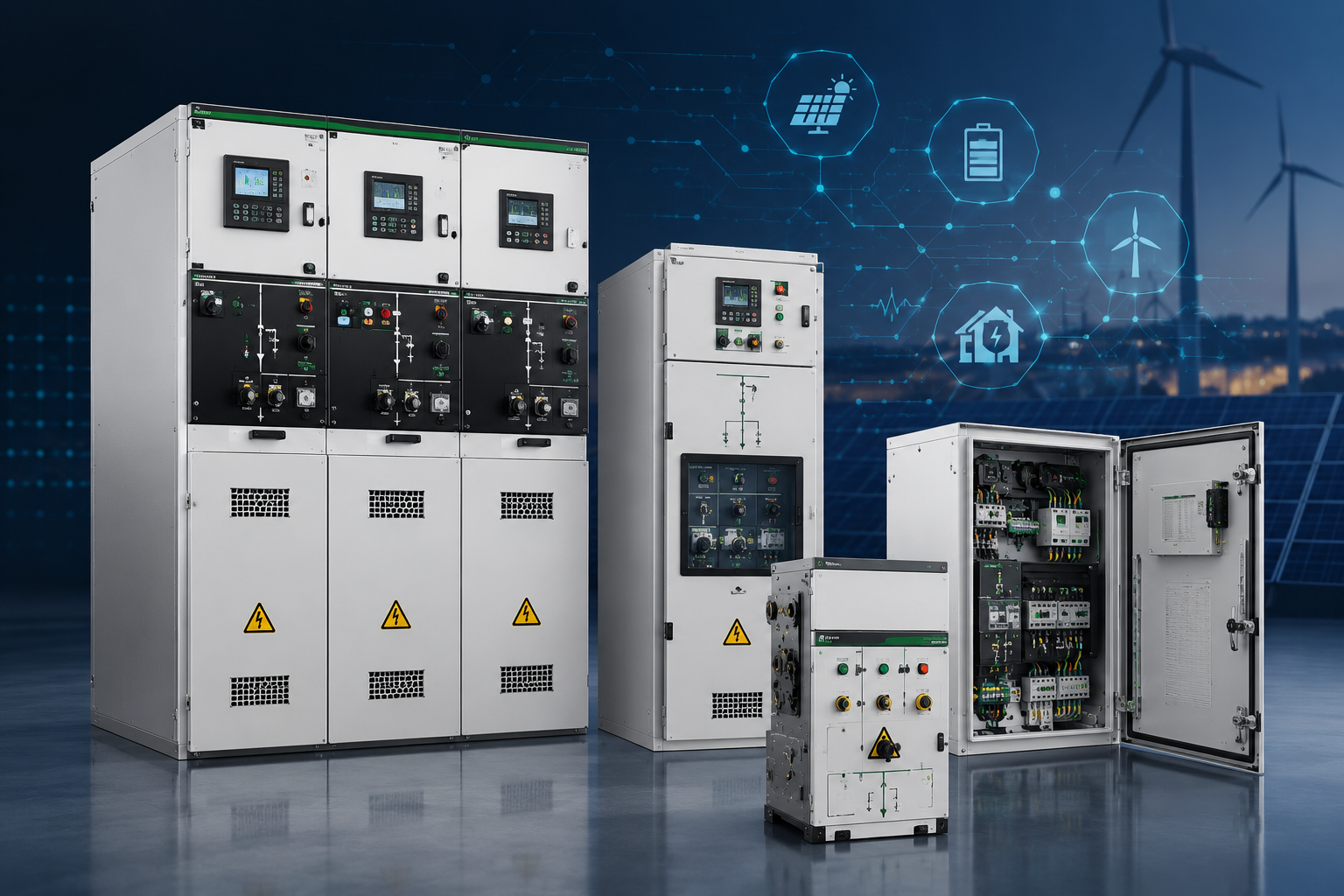
Table of Contents
1. Industry Background of Distributed Energy Grid Connection
2. Definition and Advantages of Intelligent Ring Main Unit
3. Primary and Secondary Integration Technology Core Principles
4. Fault Self-Healing Function Implementation Mechanism
5. Performance Data Comparison with Traditional Power Distribution Equipment
6. Typical Application Scenarios and Technical Value
7. Professional Industry Q&A
1. Industry Background of Distributed Energy Grid Connection
Distributed energy resources including rooftop photovoltaic, small wind power and distributed gas power generation, are growing rapidly in global power grids.
Unlike traditional centralized power supply, distributed energy grid connection brings bidirectional power flow and complex fluctuation problems.
Traditional distribution cabinets lack real-time monitoring and rapid protection capabilities. It cannot adapt to high-penetration new energy access.
Intelligent ring main unit becomes the key terminal equipment to solve distributed energy grid connection pain points in recent years.
2. Definition and Advantages of Intelligent Ring Main Unit
Intelligent ring main unit is a new generation of intelligent power distribution equipment for urban and rural power grid terminal networks.
It integrates switchgear, sensing module, communication unit and edge computing function in one compact device.
Compared with conventional ring cabinets, intelligent models support real-time data collection, remote adjustment and automatic grid scheduling.
It greatly improves the flexibility and safety of distributed energy grid connection operation.
3. Primary and Secondary Integration Technology Core Principles
Primary and secondary integration is the core technical feature of modern intelligent ring main unit.
Traditional power distribution equipment separates primary power equipment and secondary control system with independent installation.
This separated structure leads to delayed signal transmission and inconsistent data calibration.
The integrated design integrates primary switch body and secondary sensing, protection and communication modules.
It realizes synchronous collection of voltage, current and switch status data, supporting precise grid connection control.
4. Fault Self-Healing Function Implementation Mechanism
Fault self-healing is an intelligent operation function specially designed for distributed energy grid fluctuation and line faults.
When grid surge, short circuit or power fluctuation occurs, the system can quickly identify fault points through real-time data analysis.
The intelligent ring main unit will automatically isolate faulty sections and restore power supply of non-fault areas in seconds.
This function effectively avoids large-scale power outage caused by distributed energy access instability.
5. Performance Data Comparison with Traditional Power Distribution Equipment
The following test data comes from IEEE power distribution system operation standard test, which intuitively reflects the performance improvement of intelligent ring main unit.
Equipment Type | Data Response Delay | Fault Processing Time | Distributed Energy Grid Adaptability | Grid Fault Self-Healing Rate |
Traditional Separated Distribution Cabinet | 200-300ms | 3-5min Manual Processing | Low (Easy to Generate Fluctuation) | 0% |
Intelligent Ring Main Unit (Primary and Secondary Integration) | ≤20ms | ≤5s Automatic Processing | High (Stable Bidirectional Power Flow) | 98.6% |
Data shows that primary and secondary integration technology greatly reduces system response delay.
The fault self-healing function almost eliminates manual intervention and improves power grid operation reliability hugely.
6. Typical Application Scenarios and Technical Value
Intelligent ring main unit is widely used in industrial park distributed photovoltaic grid connection scenarios.
It can stabilize intermittent power output of new energy and avoid grid voltage flicker.
It also applies to residential district distributed energy stations and rural micro-grid construction.
The integrated structure reduces equipment installation space and later operation and maintenance costs effectively.
7. Professional Industry Q&A
Q1: What is the core advantage of primary and secondary integration technology?
A1: It eliminates signal delay and calibration errors caused by separated installation. It realizes high-precision synchronous control of power grid data, which is the foundation of intelligent fault self-healing.
Q2: How does fault self-healing improve distributed energy grid connection stability?
A2: It can quickly isolate fault lines and restore power supply automatically. It avoids whole-network outage caused by new energy power fluctuation and improves grid anti-interference ability.
Q3: Why traditional ring cabinets cannot adapt to distributed energy grid connection?
A3: Traditional equipment has slow data response and no intelligent judgment function. It cannot cope with bidirectional power flow and intermittent power supply characteristics of distributed energy.
Q4: What scenarios are suitable for intelligent ring main unit deployment?
A4: It is suitable for photovoltaic parks, wind-storage microgrids, industrial and residential distributed energy grid connection scenarios requiring high power supply reliability.