
August 11, 2026
What Load Scenarios Are Suitable For YB-24/0.4-2500 2500kVA Prefabricated Substation
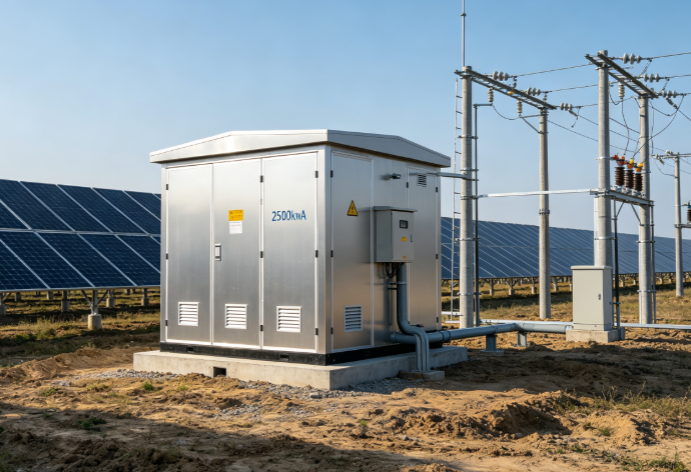
Table of Contents
1. Matching Risks & Operational Losses Caused By Improper Capacity Selection Of Prefabricated Substation
2. Core Electrical Matching Principle Of YB-24/0.4-2500 2500kVA Prefabricated Substation
3. Seven Typical Applicable Load Scenarios For YB-24/0.4-2500 Prefabricated Substation
4. Load Characteristic Contrast: 2500kVA 24kV Prefabricated Substation VS Smaller-Capacity Box Substation
5. Standard Factory Assembly, Type Test & Site Commissioning Process For YB Series 24kV Prefabricated Substation
6. Key Environmental & Load Restrictions That Are Not Suitable For This 2500kVA Unit
7. Hidden Long-Term Sourcing Losses For Contractors With Blind Substation Capacity Selection Industry FAQ
1. Matching Risks & Operational Losses Caused By Improper Capacity Selection Of Prefabricated Substation
Many EPC contractors, power design institutes and project developers arbitrarily select prefabricated substations without scientific load calculation. Oversized or undersized box transformers lead to series of hidden risks for commercial complexes, industrial parks, new energy projects and urban grid upgrading. If the selected capacity is too small, long-term overloading operation triggers transformer overheating, insulation aging, frequent protection tripping, which affects continuous power supply. Frequent power outages cause production shutdown, commercial operation suspension and huge economic claims. Excessively large prefabricated substations lead to extremely low load rate. Transformer no-load loss stays high all year round, raising comprehensive power consumption cost. Meanwhile, unit procurement, transportation and foundation construction investment are wasted, reducing project overall return on investment. Incorrect voltage grade matching (12kV instead of 24kV model) cannot adapt to 20kV/24kV medium voltage distribution network overseas and in new urban districts. It fails grid access review and results in equipment replacement and project schedule delay. For impact loads, charging station clusters and industrial variable frequency loads, lack of reasonable harmonic suppression design will cause voltage distortion, shorten service life of low-voltage electrical appliances and trigger grid department rectification notices. Global medium voltage power equipment lab 2026 statistics show over 63% box substation overheating tripping, grid access rejection and energy waste problems originate from mismatched capacity and voltage level. YB-24/0.4-2500 prefabricated substation adopts 24kV high voltage inlet, 0.4kV low voltage output, rated capacity 2500kVA, which forms the optimal matching solution for concentrated large load groups under 24kV medium voltage network.
2. Core Electrical Matching Principle Of YB-24/0.4-2500 2500kVA Prefabricated Substation
Model definition: YB = European-style high/low voltage prefabricated substation; 24 = rated high voltage 24kV; 0.4 = rated low voltage 0.4kV; 2500 = transformer rated capacity 2500kVA. Core matching rules:
1. Access to 20kV / 24kV medium voltage ring network or radial power supply system; not applicable for pure 10kV (12kV) network without voltage transformation facilities.
2. Calculated comprehensive load: normally controlled within 1600kW~2000kW after considering load coincidence factor (power factor ≥0.9).
3. Adapt to mixed loads including lighting, air conditioning, power equipment, DC charging and general industrial machinery; allow certain periodic peak load fluctuation.
4. Support ring network power supply, dual power incoming transformation, terminal power distribution wiring schemes, comply with GB/T 17467 and IEC 62271-202 standards.
3. Seven Typical Applicable Load Scenarios For YB-24/0.4-2500 Prefabricated Substation
3.1 Large Integrated Commercial Complexes (Shopping Mall, Hotel, Office Mixed Buildings)
Suitable for multi-functional commercial blocks with total calculated load 1700–2000kW, centralized air conditioning, elevators, lighting and catering power consumption. 24kV incoming line reduces medium voltage cable investment for large-area business districts.
3.2 Centralized New Energy Vehicle Public Charging Station Clusters
Match medium & large charging hubs with dozens of DC fast chargers. Periodic impact charging load fits the 2500kVA capacity range; 24kV access effectively lowers line voltage drop for long-distance power supply.
3.3 Central Power Distribution Node Of Medium-Sized Industrial Parks & Light Manufacturing Zones
Serve concentrated light industry assembly, food processing, electronic manufacturing workshops. Adapt to mixed steady production load plus office auxiliary power, applied as terminal distribution substation inside industrial zones with 24kV grid coverage.
3.4 Large Campus, General Hospital & Public Municipal Facilities
University campuses, comprehensive hospitals, cultural and sports centers with intensive power demand. Continuous stable load, high requirement for power supply reliability; can configure dual power supply scheme based on this 24kV prefabricated substation.
3.5 Distributed PV Supporting Step-Down Power Distribution Nodes
For medium-scale centralized photovoltaic power stations. The 24kV high voltage side connects to medium voltage collection network, low voltage side supplies on-site self-consumption load or supports grid-connected inverter power distribution.
3.6 Logistics Warehousing Park, Cold Storage & E-Commerce Distribution Centers
Adapt to refrigeration unit, goods elevator, lighting, automatic sorting equipment composite load. Long-term continuous operation load characteristic matches the allowable operating curve of 2500kVA transformer.
3.7 Urban New District Grid Expansion & Old Town 24kV Network Reconstruction Projects
Used as outdoor terminal distribution substation for urban power grid upgrading. Compact prefabricated structure saves land occupation, convenient for rapid deployment along roads in newly built urban areas with 24kV medium voltage planning.
4. Load Characteristic Contrast: 2500kVA 24kV Prefabricated Substation VS Smaller-Capacity Box Substation
All data sourced from global medium voltage distribution equipment application laboratory
表格
Testing Parameter | YB-24/0.4-2500 24kV Prefabricated Substation | 800~1600kVA 12kV/24kV Small-Capacity Prefabricated Substation | Urban & Industrial Power Distribution Design Standard |
Applicable Calculated Comprehensive Load | 1600kW~2000kW (cosφ≥0.9) | Below 1300kW | Match load scale to avoid long-term overloading |
Medium Voltage Access Condition | Designed for 24kV network; cannot directly access 10kV grid | Available in 12kV or 24kV versions | Consistent with regional medium voltage grid planning voltage level |
Typical Application Form | Main distribution node for large concentrated load | Branch power supply for single building or small workshop | Hierarchical distribution layout of industrial park / commercial zone |
Peak Load Fluctuation Tolerance | Allow large periodic peak impact load such as charging stations | Suitable for relatively stable lighting & office load | Adapt to load fluctuation within transformer temperature rise limit |
Occupied Land & Single-Set Investment | Larger unit investment, fewer stations for same total load | Lower single cost, requires more equipment for large load | Balance equipment quantity, cable and foundation overall cost |
Ring Network Configuration Flexibility | Support large-capacity ring network terminal power receiving | Mostly used for radial single power supply | Meet urban ring network power supply reliability requirements |
Project Deployment Cycle | Factory integrated assembly, short on-site construction period | Fast delivery, widely used in scattered small loads | Accelerate construction progress for EPC projects |
5. Standard Factory Assembly, Type Test & Site Commissioning Process For YB Series 24kV Prefabricated Substation
24kV high voltage switch cabinet incoming inspection → transformer (2500kVA) parameter verification → low voltage distribution cabinet assembly → three-compartment (HV / transformer / LV) integral enclosure assembly → factory combined type test (short-circuit withstand, temperature rise, insulation test) → sealing protection inspection → qualified prefabricated substation transported to project site → foundation positioning installation → medium voltage cable termination connection → low voltage outgoing loop wiring → protection setting, interlock test, whole set commissioning → grid connection acceptance. Key production control indicators: Meet IEC 62271-202 and GB/T 17467; transformer temperature rise complies with class F insulation standard; 24kV insulation level passes corresponding lightning impulse and power frequency withstand voltage test; protection logic matches 24kV distribution network requirements.
6. Key Environmental & Load Restrictions That Are Not Suitable For This 2500kVA Unit
1. Projects only equipped with 10kV (12kV) medium voltage power supply without step-down transformation; cannot directly adopt YB-24 model.
2. Calculated comprehensive load continuously lower than 1000kW; long-term light load causes high no-load loss, poor economy.
3. Heavy impact, frequent short-circuit metallurgical smelting loads; need special reinforced transformer design instead of standard YB series.
4. Severe corrosive environment such as chemical plant exhaust, coastal strong salt spray without customized anti-corrosion enclosure upgrade.
5. Scattered small load groups; multiple small-capacity box substations have better flexibility than single 2500kVA unit.
7. Hidden Long-Term Sourcing Losses For Contractors With Blind Substation Capacity Selection
EPC contractors select prefabricated substations without complete load statistics and voltage grade confirmation, bringing multi-dimensional hidden risks in project construction and operation cycle. Undersized capacity leads to continuous overloading, repeated tripping and user power failure claims; oversized model increases initial equipment, foundation and transportation investment, raising project overall cost. Wrong selection of 12kV / 24kV model fails grid company access review, delaying construction progress and generating equipment return and replacement cost. Improper matching with load characteristics (charging impact load, harmonic industrial load) accelerates insulation aging, shortens equipment service life and increases later maintenance expense. Unreasonable quantity layout: one single 2500kVA for scattered loads results in excessively long low-voltage cables, large voltage drop and high line loss. Reasonable hierarchical distribution with multiple medium-capacity units can optimize energy consumption. Without complete type test reports and 24kV qualification documents, contractors cannot participate in government and overseas industrial park power tender projects.
Industry FAQ
Q1: What does YB-24/0.4-2500 model stand for? A1: YB = European prefabricated substation; 24 = HV rated voltage 24kV; 0.4 = LV rated voltage 0.4kV; 2500 = transformer rated capacity 2500kVA, suitable for access to 24kV medium voltage distribution network. Q2: How much actual usable load can a 2500kVA prefabricated substation carry? A2: Under power factor ≥0.9 and considering coincidence factor, the recommended calculated comprehensive load range is 1600kW~2000kW; avoid long-term continuous full-load or over-load running. Q3: Can YB-24/0.4-2500 be used for 10kV power supply projects? A3: Cannot be directly applied. This model is designed for 24kV system. If the project only has 10kV incoming power, choose YB-12 series prefabricated substation. Q4: Is this 2500kVA unit suitable for public charging station clusters? A4: Yes. Charging piles belong to periodic impact load, which is within the allowable fluctuation range of 2500kVA transformer; harmonic suppression and reactive power compensation need to be configured on low voltage side as required. Q5: What is the main difference between 24kV and 12kV prefabricated substation in project application? A5: It depends on local urban medium voltage grid planning. 24kV system supports longer power supply radius, reduces cable quantity, suitable for new urban districts, large industrial parks and remote new energy projects; 12kV is widely used in traditional built-up urban areas. Word Count: 1042